Hypertension (High Blood Pressure) | Medtick

Hypertension (High Blood Pressure)

What is it?

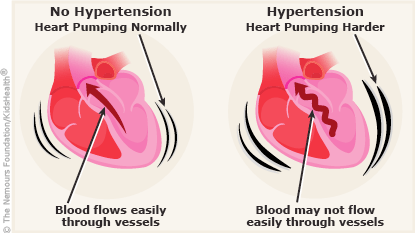
When the blood flow from the heart to the organs (i.e. liver, kidney, pancreas, brain) is not enough, the kidneys then release chemicals to increase blood flow from the heart to the rest of the body causing high blood pressure, making the heart work harder.

  • This then causes the heart to always work harder and hence one has high blood pressure continuously.
  • It also makes the heart less efficient  and it then has too work even harder over time , hence ones blood  pressure go up over time
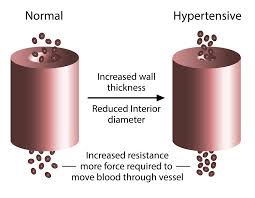
  • The blood vessels normally stretch and de-stretch (pulse) to cope with normal blood pressure but with high blood pressure it looses that stretching motion and becomes more stiff and narrow , this can raise blood pressure even further as wells fats and cholesterol, blood  begin to clog up and this can led to a blockage and eventually an heart attack and/or angina and/or stroke (if arteries are in the brain) .
  • Most blood pressure is of unknown cause (essential or primary hypertension).
  • Less than 10% is caused by an underlying cause (secondary hypertension).

Taking blood pressure tips:

  • Don’t have a conversation
  • Support the arm at heart level
  • Use the correct cuff size (do not use wrist ones, or watch devices or apps, debatable if they provide accurate results).
  • Put the cuff on a bare arm
  • Support the feet, keep the legs uncrossed
  • Ensure the patient has an empty bladder, and support the back
  • Most guidelines recommend taking three readings, the “pragmatic” focus proposed in the international consensus accepts at least two readings separated by a minimum of 30 seconds. The two readings should then be averaged out.

Three ‘Synergistic’ Problems When Taking Blood Pressure

Matías Loewy June 07, 2023 Medscape


Reading blood pressure on devices

  • Systolic blood pressure is the higher value reading on your blood pressure device, it tells you the pressure in your blood vessels/arteries generated when the heart beats.
  • Diastolic blood pressure is the lower value reading on your blood pressure device and tells you the pressure of your blood vessels/arteries between heart beats.


Reading Result Action
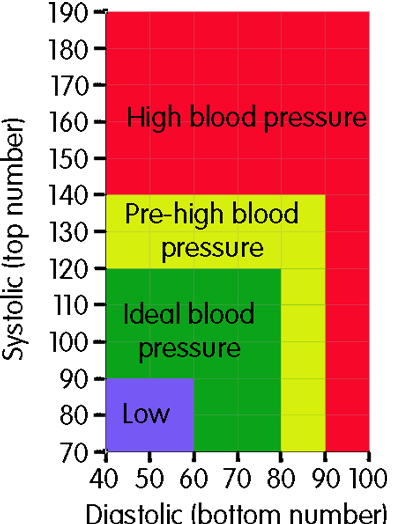
  • (90/60) or less
  • If your top number is 90 or less more regardless of bottom number
  • If your bottom number is 60 or less regardless of top number


  • Low blood pressure
  • See Medical Doctor
  • Drink more water
  • (90/60) and less (120/80):
  • Ideal and healthy
  •  Great !!
  • (120/80-140/90):
  • Slightly high blood pressure
·        (140/90) or higher

·        If your top number is 140 or more regardless of bottom number


  •  If your bottom number is 90 or more regardless of top number


  • High blood pressure
  • See Medical Doctor


Terms of hypertension:

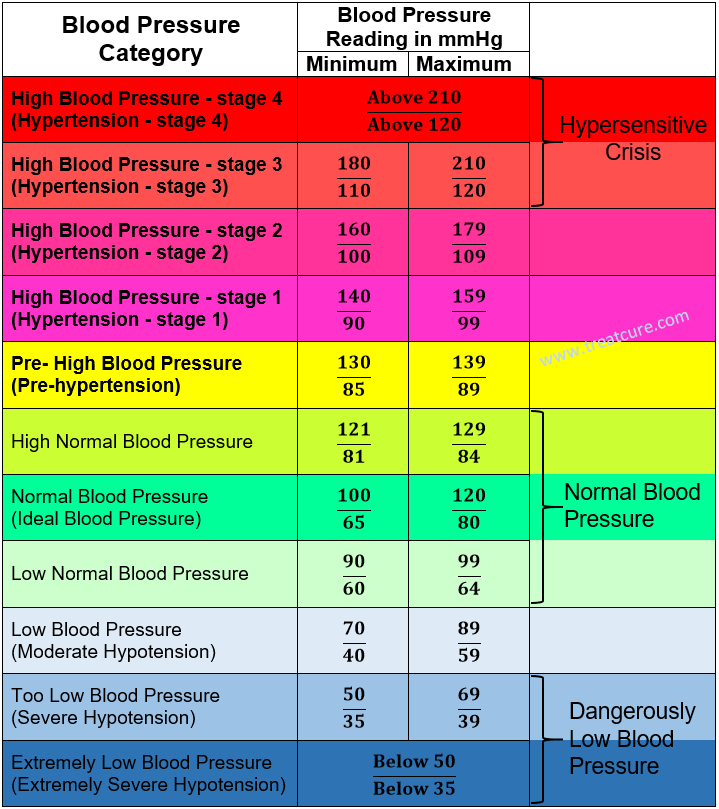
  • Prehypertension: Blood pressure that is higher than the desirable range, but not high enough to be labeled hypertension. In prehypertension, the systolic pressure is 120 to 129 mmHg and the diastolic pressure is less than 80 mmHg.
  • Stage 1 hypertension: Systolic pressure 130 to 139 mmHg or diastolic pressure 80 to 89 mmHg
  • Stage 2 hypertension: Systolic pressure greater than 139 mmHg or pressure diastolic greater than 89 mmHg

verywellHealth

Resistant hypertension

  • Resistant hypertension (defined as a blood pressure ≥ 140/90 mm Hg despite concurrent use of three antihypertensive medications from different classes, including a diuretic), onset at an age younger than 30 years, acute worsening of blood pressure control, severe hypertension (> 180/120 mm Hg), and malignant hypertension with end-organ damage.

Puar TH, Mok Y, Debajyoti R, Khoo J, How CH, Ng AK. Secondary hypertension in adults. Singapore Med J. 2016;57:228-232. Source

Charles L, Triscott J, Dobbs B. Secondary Hypertension: Discovering the Underlying Cause. Am Fam Physician. 2017;96(7):453-461. Source


New guidelines for hypertension and blood pressure and exercise regimens

  • 2024 ESC Guidelines for the management of elevated blood pressure and hypertension
  • Please click link below in regarding exercise regimens.

Developed by the task force on the management of elevated blood pressure and hypertension of the European Society of Cardiology (ESC) and endorsed by the European Society of Endocrinology (ESE) and the European Stroke Organisation (ESO)

Medscape

(Please ask a medical healthcare professional i.e. pharmacist/Medical Doctor if unsure about the readings)

Cause


  • Overweight – Obesity and hypertension have a well-studied dose-response relationship, with the often-cited Framingham Heart Study showing that the risk for hypertension increases 20%-30% for every 5% increase in body weight. According to a recent systematic review and meta-analysis, lowering a patient’s body weight can reverse this effect, and a mean BMI reduction of 2.27 leads to a decrease in systolic and diastolic blood pressure of 5.79 mm Hg and 3.36 mm Hg, respectively. This is also consistent with a recent review published in JAMA, which found that a 5%-10% decrease in weight led to reductions of 3 mm Hg in systolic blood pressure.

Medscape


Syndromes

Medication

  • Decongestants
  • Remedies containing liquorice:(i.e. throat and/or chesty cough medicines)
  • NSAID (non-steroidal anti-inflammatory drugs e.g. Aspirin, Ibuprofen)
  • Corticosteroids (steroids)
  • Kidney disease anaemic drugs: Erythropoietin (Neorecormon, Eprex)
  • Antifungal: Ketoconazole (Nizoral)
  • MAOI Antidepressant
  • Effervescent (soluble sachets and tablets) formulations contain high sodium levels
  • Medication used in long term pain relief: Nalaxone
  • Migraine medication
  • Any Oestrogen containing medication: Oral contraceptives,Hormone replacement therapy (HRT), Oestrogen supplements
  • Immunosuppressant: Tacrolinmus (Prograf, Advograf), Ciclosporin (Neoral)
  • Drugs used in pain relief or attention deficit disorders or over excited disorders: Cocaine, Amphetamines, Crystal methamphetamines

Illicit drugs

Vitamins, herbals and minerals

Resistant hypertension causes:
 

Symptoms

Male only:

Complications /Information to beware of/General tips:

Do not wait, phone for ambulance if have or develop:


This condition can lead to:


Pregnancy

Definition of High Blood Pressure in Pregnancy
Hypertension in pregnancy is defined as two or more blood pressure readings of at least 140 mm Hg systolic or 90 mm Hg diastolic, measured 4 hours apart. Severe hypertension in pregnancy is defined as blood pressure of at least 160 mm Hg systolic or 110 mm Hg diastolic.
For treatment purposes, severe hypertension can be diagnosed with measurements at least 15 minutes apart.Tita AT, Szychowski JM, Boggess K, et al. Treatment for mild chronic hypertension during pregnancy. N Engl J Med. 2022;386:1781-1792.

Hypertension in pregnancy includes:

  • Chronic hypertension: precedes pregnancy, develops before 20 weeks of gestation, persists for >6 weeks post-partum, and may be associated with proteinuria.

  • Gestational hypertension: develops after 20 weeks of gestation and usually resolves within 6 weeks post-partum.

  • Antenatally unclassifiable hypertension: BP is first recorded after 20 weeks of gestation, and hypertension is diagnosed but it is unclear if chronic or not; reassessment is necessary 6 weeks post-partum.

Developed by the task force on the management of elevated blood pressure and hypertension of the European Society of Cardiology (ESC) and endorsed by the European Society of Endocrinology (ESE) and the European Stroke Organisation (ESO)


  • Almost half of women who have pregnancy-related hypertension continue to have high readings at 6 weeks postpartum.

Ditisheim A, Wuerzner G, Ponte B, et al. Prevalence of hypertensive phenotypes after preeclampsia: a prospective cohort study. Hypertension. 2018;71:103-109.

Hauspurg A, Lemon L, Cabrera C, et al. Racial differences in postpartum blood pressure trajectories among women after a hypertensive disorder of pregnancy. JAMA Netw Open. 2020;3:e2030815. 


Driving Authority


Over 40 years old (please make sure you have a blood pressure examination)?

Low blood pressure

  • If one has low blood pressure (90/60mmHg or lower) and is fainting or feel like they will faint, please see your doctor on the same day, if one has no symptoms , do an annual blood pressure check up but please be aware of low blood pressure symptoms and if they do occur then see your doctor on the same day.

High blood pressure:

Average Normal blood pressure: Between 90/60mmHg and 134/84mmHg

Average Stage 1 Hypertension: Between 135/85 mmHg and 149/94 mmHg

  • Please consider further blood pressure monitoring (Ambulance Blood pressure monitoring, this device measures your blood pressure during a 24 hour period) and one should make an appointment with a doctor with in two weeks (if you experience high blood pressure symptoms , do not wait, see your medical doctor on the same day).
    • The device must not get wet, baths and showers avoided during 24 hour period.
    • The device will take measurements every 30 minutes during waking hours and every 60 minutes during sleeping hours for 24 hours.
    • You will be alerted just before the monitor is about to take a reading, when this occurs:
      • Try to sit down, if possible
      • Position the arm that has the cuff on it at the same level as your heart and keep your arm still.
      • If you are not able to sit down, use your other arm to support you to achieve this position.
      • if you are sitting down, do not cross your legs during the measurement.
      • You are advised not to drive during the 24 hour period due to distraction of the cuff inflating.
      • Avoid vigorous exercise during the 24 hour monitoring period, this will help to avoid exercise related spikes in your blood pressure. A gentle or brisk walk is normally fine.
      • Monitoring will continue at night, so consider where you place the device if it is not directly attached to the cuff i.e. under the pillow or on a bedside table.
      • Please make a note of the time if one takes any type of medication and the time of any activities during the monitoring period.

Average Stage 2 Hypertension: Between 150/95 mmHg or higher:

  • This is urgent and one should see their doctor on the same day.

This condition may show similar symptoms to:

Please talk to your healthcare professional (i.e. Medical Doctor/Pharmacist) for further advice

Detailed Information

Please copy and paste any key words from the title: Hypertension (High Blood Pressure) in the following respective 'Medtick References and/or Sources' to find out more about the disease (this also may include diagnosis tests and generic medical treatments).

  • Medical News Today

    Medical news and health news headlines posted throughout the day, every day.

  • Medscape (Professional level)

    Latest medical news and expert commentary in your specialty as well as disease information.

  • Healthline

    Medical Information and health advice you can trust

  • EveryDay Health

    Wellness inspired. Wellness enabled.

  • Pharmaceutical Journal (Professional level)

    The Pharmaceutical Journal covers analysis, features, opinion, learning and careers articles, providing insight and knowledge about drugs, pharmacy practice, medicines use and healthcare policy in the context of the pharmacy profession and pharmaceutical science.

  • NHS

    Find information and advice on health conditions, symptoms, healthy living, medicines and how to get help (British National Health Service).

  • WebMD

    Better Information. Better Health.

  • Cleveland Clinic

    Pushing the Standards of care.

  • Mayo Clinic

    No.1 Hospital in the Nation (America)

  • Drugs.com

    Know more. Be sure.

  • National Organisation of Rare Diseases

    NORD is dedicated to supporting education, elevating care, advancing research, and driving policy for rare diseases.

  • Verywell Health

    Know more. Fell better.

  • Nathnac

    Travel health guidance for health professionals advising travellers and for travellers going overseas from the UK.

  • DR Axe

    Health and fitness news. Recipes, Natural Remedies

  • Better health - NHS

    Healthy changes start with little changes. Whether you want to lose weight, drink less alcohol, get active or quit smoking, you have access to lots of free tools and support through Better Health. You can also find simple ways to lift your mood with Every Mind Matters.

    There has never been a better time to kickstart your health. Let’s do this!

Diet, Exercise and Body Manipulations

Exercise studies

  • Low-middle intensity aerobic exercise was most effective at lowering systolic blood pressures among tested exercise strategies in young to middle-aged adults with prehypertension or hypertension.
  • Only low-middle intensity aerobic exercise was associated with significant improvements in triglycerides, high-density lipoprotein, low-density lipoprotein, and BMI.
  • High-intensity aerobic exercise and high-intensity resistance exercise might reduce diastolic blood pressure.

Medscape

Aerobic exercise include:

  • Brisk walking.
  • Elliptical machines i.e. cross trainer machines
  • Cycling.
  • Stationary rowing.
  • Swimming laps.
  • Jogging.
  • Running.

Diet

  • Consider calorie restriction, specifically the DASH diet, is the most effective intervention for lowering blood pressure through weight loss. The review cites a comprehensive meta-analysis, which notes “aerobic exercise, isometric training, low‐sodium and high‐potassium salt, comprehensive lifestyle modification, salt restriction, breathing‐control, meditation and low‐calorie diet also have obvious effects on blood pressure reduction,” but low-calorie diets could lower blood pressure more than exercise alone.
  • The DASH diet involves low intakes of fat, sugar, and salt and high consumption of fruits, vegetables, whole grain, and lean protein.
  • It may have an even greater anti-hypertensive effect than the Mediterranean diet.

Medscape