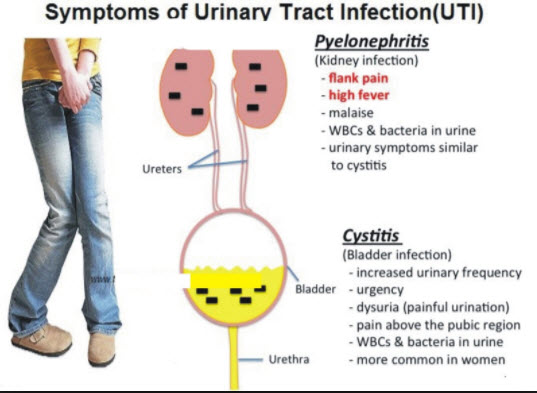
When the urinary tract (urethra) gets infected by bacteria (Bladder infection) usually from:
Our immune system can usually stop the bacteria but at times the bacteria travels upwards along the ureters towards kidneys, here it can multiply into a full-blown infection and one has more severe symptoms.
Those with weak immune systems
- Patients who are have increased complications of kidney infection are:
Do not wait, If one has flank pain, new or different muscle pains or flu-like symptoms, fever, nausea, or vomiting, please see your medical Doctor urgently and rule out pyelonephritis or if one has severe symptoms below. if possible take a urine sample with you for analysis and testing to give one the right treatment
Females have a much higher risk of kidney infections compared to males because:
- Female have a shorter urethra, which allows bacteria to reach and infect the bladder far more easily.
- Opening to the urethra in females is significantly closer to the rectum, where Urinary tract infection – causing bacteria are known to settle and grow.
- Males have prostate fluids and semen which is believe to help against infections.
Recurrent urinary tract infections (rUTI):
- Recurrent urinary tract infections (rUTI) as ≥ 2 culture-proven symptomatic UTIs in 6 months or ≥ 3 in 12 months, and recommends confirming prior episodes with documented positive urine cultures before giving antibiotics or prevention treatments.
Regular urine infections can lead to the following risk factors:
- Outflow obstruction to benign prostate hyperplasia (prostate gland is enlarged and not cancerous)
- Urethral strictures (scarring that narrows the tube that carries urine out of the body, called the urethra leading to les urine output)
- Lack of nerve control on the bladder (leading to poor urine outflow and urinary retention)
- Oestrogen depletion
- Urine and/or faecal incontinence (going to the toilet more often than usual)
- Urine catheterization (need of a catheter)
Children
Upper-tract UTIs, such as pyelonephritis, involve the kidneys and are associated with symptoms such as fever, abdominal pain and nausea. These infections carry a higher risk of renal scarring — especially in younger children — and may require hospitalisation and IV antibiotics
Urinary tract infection – children. National Institute for Health and Care Excellence . 2024. https://cks.nice.org.uk/topics/urinary-tract-infection-children
Recurrent UTIs in children
Recurrent UTIs in children can occur even after proper treatment and may indicate an underlying anatomical or functional abnormality, with a diagnosis made if any of the following scenarios occur:
- Two or more episodes of UTI with acute pyelonephritis or upper UTI;
- One episode of acute pyelonephritis or upper UTI, plus one or more episodes of cystitis or lower UTI;
- Three or more episodes of cystitis or lower UTI.
Recurrent urinary tract infections (UTIs). Nemours KidsHealth. 2021. https://kidshealth.org/en/parents/recurrent-uti-infections.html
Kaufman J, Temple-Smith M, Sanci L. Urinary tract infections in children: an overview of diagnosis and management. bmjpo. 2019;3(1):e000487. doi:10.1136/bmjpo-2019-000487
- These cases often warrant specialist advice.
- Prophylactic antibiotics may be considered after optimising behavioural and hygiene measures.
Urinary tract infection – children: Management of recurrent UTI in children. National Institute for Health and Care Excellence . https://cks.nice.org.uk/topics/urinary-tract-infection-children/management/recurrent-uti-in-children/
Diagnosis Test
Children
- All children with a suspected UTI should be assessed for risk of serious infection.
- Those identified as high-risk, such as children who are systemically unwell, showing signs of sepsis or with concerning clinical features, should be referred urgently to an appropriate specialist.
- In the community or primary care setting, this usually means referral to the on-call paediatric team at the nearest hospital or to emergency services if the situation dictates.
- This team can consist of nurses and paediatric doctors, to infectious diseases consultants.
- Antibiotic treatment should be started without delay, even if a urine sample has not yet been obtained.
A urine sample should be sent for microscopy and culture in the following circumstances:
- Children with fever ≥38°C without a clear source;
- Suspected pyelonephritis;
- If they remain unwell after 24 hours despite having another identified or suspected source of infection (e.g. respiratory tract infection, otitis media, skin infection).
- In children aged under three months, urgent referral to a specialist is needed for the initiation of parenteral antibiotics and a urine sample should always be sent.
- In children aged over three months, a dipstick test should be performed and management should be based on the results.
The Pharmaceutical Journal, PJ, September 2025, Vol 315, No 8001;315(8001)::DOI:10.1211/PJ.2025.1.375188
Others:
- Urine tests
- White blood cells (pyuria)
- Leukocyte esterase
- Nitrites (often indicate certain bacteria)
- Blood in urine (haematuria)
- Bacteria
- Urine culture
- Blood tests
- Complete blood count
- CRP and/or ESR
- Blood culture- to detect bacteria
- Kidney function tests
- Imaging tests i.e. Kidney stones
- Kidney ultrasound
- CT scan of pelvis
- Tests for structure of kidney
- Tests for urinary reflux
- Physical pelvic exam
Cause
- Bacteria:
- E.Coli (living in colon)
- Klebsiella
- Proteus mirabilis
- Enterobacter
- Pseudomonas aeruginosa
- Staphylococcus saprophyticus (naturally found in the vagina)
- Any condition where one does not fully empty their bladder and/or hold urine in and/or blockage of urine flow.
- Bacteria from anus to genital region via wiping and sexual activity
- Uncircumcised men may harbour harmful bacteria under the foreskin.
- Sexual intercourse
- Using external perfumed/soaps/washes (bacteria a chance to invade)
- Spermicidal lubricants can trigger genital inflammation
- Catheters and/or Diaphragms can promote the growth of coliform bacteria i.e. E. coli. and/or Biofilms (communities of bacteria that adhere to surfaces and produce a protective matrix. This matrix allows bacteria to evade the host’s immune response and resist antibiotics) i.e. E. coli. P. aeruginosa, Enterococcus and Klebsiella.
- Cystitis
- Thrush
- Skin infection (rare)
- Pregnancy
- Alzheimer’s and Dementia (affect personal hygiene and changes in acidity can affect the condition)
- Diabetes (increase urine glucose that bacteria feed on)
- Any condition that prevent bladder from emptying fully
- Bowel conditions and diseases
- Bowel incontinence
- Enlarged prostate gland
- Kidney stones
- Posterior urethral valves (common cause of urinary tract obstruction in new born males)
- Menopause (alter the protective flora in the vagina)
- Weak immune system condition
Treatments
- Catheters and/or surgical equipment (infection due to non-sterile or prolonged use)
Medication
Risk factors for urinary tract infections (UTIs) in children
Sex
- UTIs are more common in girls than in boys, mostly owing to anatomical differences, such as a shorter urethra, higher vaginal pH and the proximity of the urethral opening to the anus.
Circumcision
- Circumcised boys aged under one year are nearly ten times more likely to develop a UTI than uncircumcised boys.
Voiding dysfunction
- Infrequent or incomplete emptying of the bladder allows urine to be retained, which creates the ideal breeding ground for bacteria and increases the risk of infection.
Absence of breastfeeding
- Breastfeeding provides infants with maternal antibodies that help to strengthen the immune system. Formula-fed infants can be more susceptible to infections, including UTIs13.
Urinary catheter use
- A catheter can serve as a direct pathway for bacteria to enter the urinary tract, which increases the risk of infection.
Poor toilet hygiene
- Improper wiping techniques can increase the risk of faecal bacteria, such as E. coli, entering the urethra.
Immunosuppression
- Children with weakened immune systems may have reduced ability to fight off infections, such as UTIs.
Anatomic abnormalities
- Structural defects, such as neurogenic bladder or vesicoureteral reflux, can impair the bladder’s ability to void urine, which increases the risk of UTIs.
Previous UTI or family history of UTIs
- This can indicate a genetic predisposition to infections including UTIs.
Morris BJ, Wiswell TE. Circumcision and Lifetime Risk of Urinary Tract Infection: A Systematic Review and Meta-Analysis. Journal of Urology. 2013;189(6):2118-2124. doi:10.1016/j.juro.2012.11.114
Shaikh N. Urinary tract infections in children: Epidemiology and risk factors. UpToDate.
Renko M, Salo J, Ekstrand M, et al. Meta-analysis of the Risk Factors for Urinary Tract Infection in Children. Pediatric Infectious Disease Journal. 2022;41(10):787-792. doi:10.1097/inf.0000000000003628
Kaufman J, Temple-Smith M, Sanci L. Urinary tract infections in children: an overview of diagnosis and management. bmjpo. 2019;3(1):e000487. doi:10.1136/bmjpo-2019-000487
Poloni JAT, Rotta LN. Urine Sediment Findings and the Immune Response to Pathologies in Fungal Urinary Tract Infections Caused by Candida spp. JoF. 2020;6(4):245. doi:10.3390/jof6040245
The Pharmaceutical Journal, PJ, September 2025, Vol 315, No 8001;315(8001)::
DOI:10.1211/PJ.2025.1.375188